The commentary of "Cross-kingdom RNA decoy redefines fungal virulence strategies" has been published on Journal of Integrative Plant Biology. Congratulations!
Plant‑pathogenic fungi severely threaten crop yield and food security. For a long time, plant‑pathogen interactions have been largely interpreted as protein‑centered offensive‑defensive processes. Plants recognize pathogenic signals or host perturbations triggered by effector proteins via immune receptors, whereas pathogens secrete effector proteins to suppress plant immunity and facilitate infection. Nevertheless, accumulating evidence indicates that information exchange between plants and pathogens is not confined to proteins. Small RNAs can move bidirectionally between plants and fungi, and plant mRNAs can also enter fungal cells and undergo translation, suggesting that cross‑kingdom RNA communication represents an emerging perspective for understanding plant‑pathogen interactions.
Recently, Dr. Xiong Zhang from the Institute of Oilseed Crops Research, Chinese Academy of Agricultural Sciences, and Professor Meixiang Zhang from Shaanxi Normal University published a commentary article entitled Cross‑kingdom RNA decoy redefines fungal virulence strategies in Journal of Integrative Plant Biology (JIPB) (https://doi.org/10.1111/jipb.70342). This commentary reviews the Nature study “A pathogen lncRNA secreted into rice sequesters a host miRNA for virulence” reported by the research team led by Professor Xuewei Chen from Sichuan Agricultural University, and systematically discusses how Magnaporthe oryzae hijacks the rice miRNA‑mediated immune pathway by utilizing long non‑coding RNAs (lncRNAs) to promote disease development.
The original study revealed that the Magnaporthe oryzae lncRNA lnc117761 is highly expressed during appressorium and invasive hypha stages. Knock‑out of lnc117761 markedly attenuated fungal virulence, while vegetative growth, stress responses and appressorium formation remained largely unaffected, indicating that this RNA is predominantly involved in host infection processes. Further assays demonstrated that disruption of its putative open reading frame did not restore virulence, supporting that lnc117761 functions as a non‑coding RNA rather than a small peptide. In‑situ hybridization assays further showed that lnc117761 translocates from fungal invasive hyphae into rice cells, providing direct evidence for cross‑kingdom movement of fungal lncRNAs.
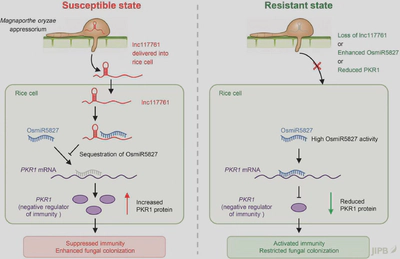
The commentary elaborates on the cross‑kingdom RNA decoy mechanism proposed in the original work. lnc117761 harbors a conserved binding site for miR5827 and is capable of RNA‑RNA pairing with rice miR5827. miR5827 acts as a positive regulator of rice blast resistance; knockout of miR5827 enhances disease susceptibility, whereas its overexpression elevates disease resistance. The study further identified PKR1 as a critical target gene of miR5827. PKR1 encodes a serine/threonine protein kinase receptor and functions as a negative regulator of rice immunity. During compatible disease interactions, Magnaporthe oryzae delivers lnc117761 into rice cells. Acting as an RNA decoy, lnc117761 sequesters miR5827 and relieves miR5827‑mediated repression of PKR1. This results in elevated PKR1 abundance, dampened host immunity, and ultimately facilitates fungal colonization (Figure 1). By contrast, upon lnc117761 deletion or disruption of lnc117761‑miR5827 pairing, miR5827 function is restored, PKR1 expression declines, and rice disease resistance is strengthened.
The commentary points out that this discovery expands the concept of pathogen effectors. Canonical effectors are mostly proteins, and cross‑kingdom small RNAs generally exert functions by silencing host target genes. Distinct from these, lnc117761 is neither a protein effector nor a small RNA that directly guides target mRNA degradation. Instead, it is a pathogen‑derived long non‑coding RNA that traps host miRNAs through sequence complementarity. This regulatory logic resembles endogenous plant target mimicry; however, the decoy RNA originates from a fungal pathogen and executes virulence functions across species boundaries. This finding highlights that RNA‑RNA pairing can serve as an important strategy exploited by pathogens to manipulate host immune systems.
Concerning future research directions, the commentary raises several open scientific questions. Whether lnc117761 binds additional plant miRNAs or participates in other infection‑associated processes requires further investigation. How lnc117761 is sorted, packaged and trafficked across the fungus‑plant interface is also key to deciphering cross‑kingdom RNA transport mechanisms. Existing evidence shows that lnc117761 is enriched in infection‑related extracellular vesicles, implying that extracellular vesicles may mediate its cross‑kingdom delivery. Moreover, it remains to be validated in additional pathosystems whether the lncRNA‑miRNA decoy mechanism represents a unique case in Magnaporthe oryzae or a widespread strategy evolved repeatedly in pathogens.
From an applied perspective, the miR5827‑PKR1 module provides promising candidate targets for genetic improvement of rice blast resistance. Boosting miR5827 activity, repressing PKR1 expression or function, or disrupting the lnc117761‑miR5827 pairing interface may enable enhanced rice disease resistance in the future. Nevertheless, before deploying these strategies in breeding programs, systematic assessments of their impacts on rice growth, yield and other stress responses are indispensable.
Collectively, this study uncovers a novel fungal virulence mode, demonstrating that molecular signals shaping plant‑pathogen interactions are not only encoded by proteins but also embedded within non‑coding RNA sequences. Dr. Xiong Zhang (first author) and Professor Meixiang Zhang are the corresponding authors of this commentary. This work was supported by the National Natural Science Foundation of China, the National Rapeseed Industry Technology System, and the Agricultural Science and Technology Innovation Program of the Chinese Academy of Agricultural Sciences.
Full text article link: https://onlinelibrary.wiley.com/doi/10.1111/jipb.70342